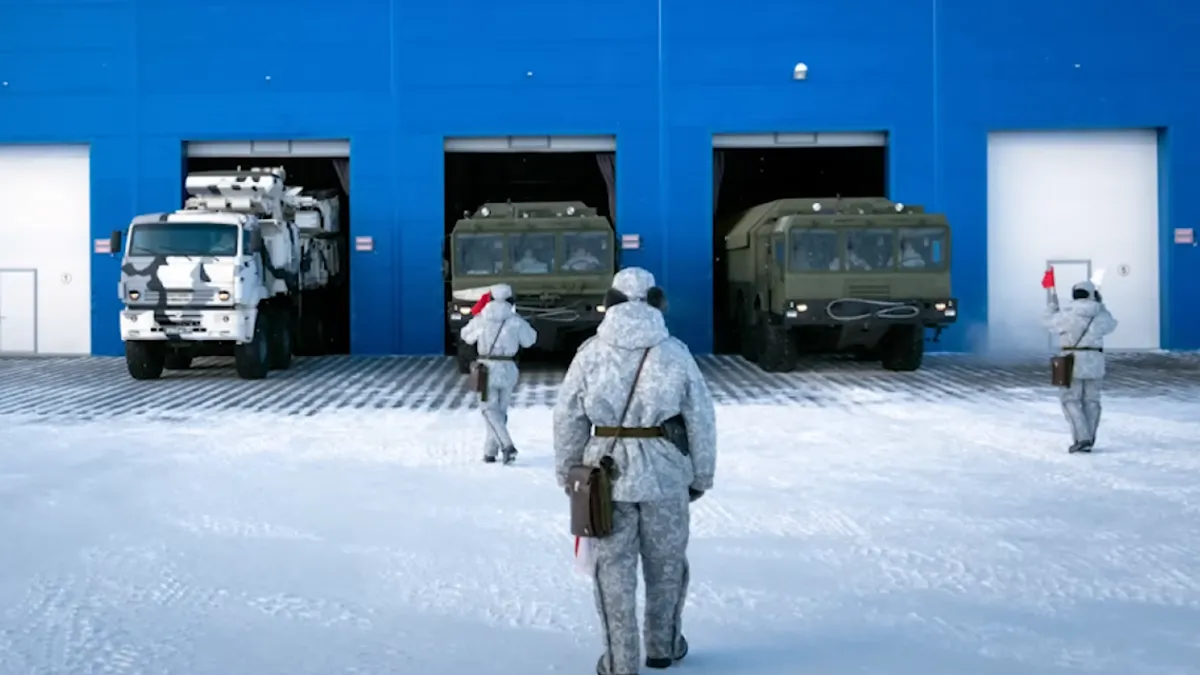
How long can we pretend that the melting of the Arctic is merely an environmental crisis? The ice is melting. The tension is rising. For decades, the High North was treated as a zone of "Arctic exceptionalism"—a peaceful, demilitarized space where nations cooperated on climate research and search-and-rescue operations. That era is dead. Today, as we navigate the complex security dynamics of 2026, the Barents Sea and the waters around Svalbard have become the primary arena for a silent, high-stakes submarine and radar war between NATO and the Russian Federation. They wanted trade. They wanted new shipping passages. They got a frontline. The physical retreat of the ice has opened up the planet's final untapped reserve of fossil fuels and rare earth minerals, and the world’s major powers are already drawing their red lines in the slush.
The Kola Bastion and the Western Alliance
The strategic equation has changed fundamentally since Sweden and Finland completed their integration into the Western alliance. On paper, Washington celebrated this as a total geopolitical victory that neutralized Russia's Baltic Fleet. In reality, it has forced Moscow to double down on its northern bastion, concentrated around the heavily fortified Kola Peninsula. From these secret Arctic bases, Russian Yasen-class nuclear submarines are quietly slipping into the North Atlantic, testing the defensive barriers of the GIUK gap and challenging our naval dominance in the High North. We are no longer dealing with the localized skirmishes of Eastern Europe; we are witnessing the slow, systematic construction of a permanent Arctic iron curtain, where a single miscalculation by a patrolling maritime patrol aircraft could spark a global escalation.
This is not a temporary buildup; it is a permanent militarization of the global commons. The United States and its Nordic allies have launched massive, recurring joint exercises, preparing their infrastructure to host advanced strategic bombers and deep-water submarine hunters on the coast of Norway. Yet, we must ask if our strategic planners truly understand the unique, unforgiving environment they are trying to conquer. Operating in the sub-zero temperatures of the Arctic requires a level of specialized engineering and rugged material endurance that our current military-industrial complex is struggling to produce. It seems that the Pentagon is running the risk of overextending its forces, committing billions of dollars to a frozen theater while leaving our strategic assets in the Indo-Pacific dangerously exposed to Chinese moves.
The Triad of Arctic Geopolitical Friction
The strategic struggle over the roof of the world is currently defined by three overlapping operational security challenges:
- The Kola Peninsula Bastion: Russia's concentration of strategic nuclear assets in Severomorsk, turning the Barents Sea into a heavily fortified transit corridor for Yasen-M class submarines.
- The GIUK Gap Surveillance Squeeze: NATO's deployment of advanced P-8A Poseidon maritime patrol aircraft and underwater sonar arrays in Norway to track Russian naval movements slipping into the North Atlantic.
- The Polar Silk Road Alliance: China's substantial financial backing of Russia's Siberian energy projects, linking Beijing's shipping ambitions with Moscow's northern sovereign corridor.
Nagurskoye and the Svalbard Question
Nowhere is this bastion strategy more visible than at Nagurskoye, Russia's northernmost military installation on Alexandra Land in the Franz Josef Land archipelago, barely 350 kilometers from Norway's Svalbard islands. The base's runway is currently being extended from 2,400 to roughly 3,600 meters, an upgrade that would allow it to host long-range strategic bombers rather than just fighter jets—a shift from regional policing to something closer to a forward power-projection platform. Satellite imagery has not confirmed the air-defense systems some analysts believe may already be in place there, and the Center for Strategic and International Studies has been careful to note that much of this remains assessed capability rather than verified fact.
What makes Nagurskoye's proximity to Svalbard more than an academic curiosity is the archipelago's peculiar legal status. Under the 1920 Svalbard Treaty, Norway holds sovereignty but is barred from militarizing the islands, while every signatory—including Russia—retains equal economic rights there. The practical result is that Norway cannot maintain a conventional defensive presence on its own territory without inviting accusations of treaty violation, even as its official security posture now describes the relationship with its eastern neighbor in far starker terms than a decade ago. Some Arctic security researchers have modeled scenarios in which airborne forces could reach the undefended archipelago within hours, given the nearest Norwegian base sits roughly twice as far away—though this remains a theoretical stress-test of NATO's reach, not a forecast.
Most Arctic analysts remain skeptical that Moscow is actually preparing an invasion; Russia already enjoys most of the economic access it wants under the existing treaty, and its military is stretched thin by Ukraine. The more plausible near-term risk, according to recent transatlantic risk assessments, is not tanks on the tarmac but a slower campaign of cyber intrusions, telecom disruption, and disinformation—designed less to seize Svalbard than to test how far the alliance's patience actually extends.
The quiet war under the ice is arguably the defining geopolitical challenge of the next twenty years, yet it remains almost entirely invisible to the average citizen. We focus our attention on the highly visible, dramatic conflicts in the Middle East and Eastern Europe, ignoring the silent pings of sonar beneath the Arctic ice caps. But as the northern shipping routes become more viable with each passing summer, the battle for control over these emerging trade lanes will only intensify, forcing us to make difficult decisions about where to deploy our defensive shields. If we continue to treat the High North as a secondary priority, we may wake up to find that Russia—supported by massive Chinese investments in its Polar Silk Road initiative—has already secured total hegemony over the roof of the world. As we prepare for a long, cold winter of strategic positioning, we must ask ourselves the ultimate question: are we prepared to fight for a frozen ocean, or have we already lost the battle for the top of the world?