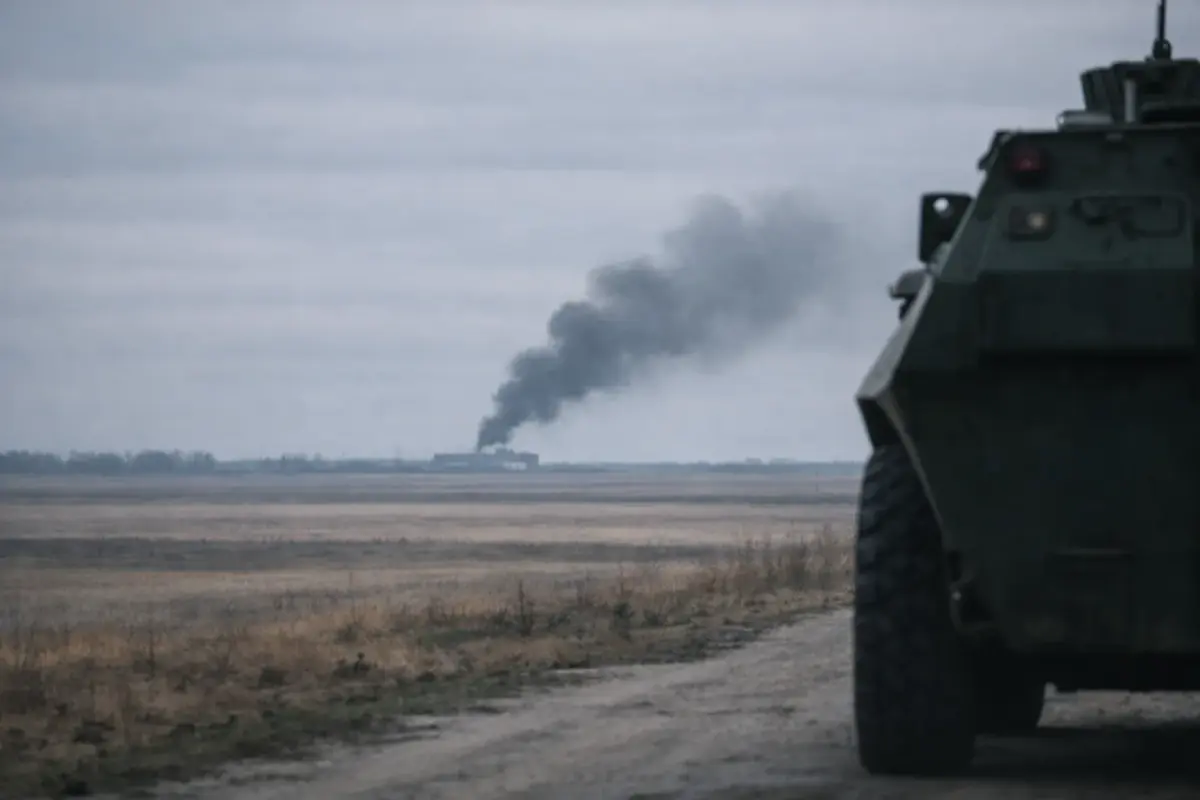
It is striking how Ukrainian and Russian sources can describe the same strikes and security incidents through radically different lenses. The underlying events may be broadly acknowledged on both sides, yet the emphasis, interpretation, and perceived consequences can be completely different. In this information war, how an event is framed can be almost as consequential as the facts themselves. Here are three examples of how Ukrainian and Russian sources presented the same episodes in sharply contrasting ways.
Attacks Against Oil Infrastructure in Krasnodar and Volgograd
Unmanned aerial vehicles struck the Tamanneftegaz oil terminal in Russia's Krasnodar region and an oil-processing and pumping facility near Kotovo in the Volgograd region.
Ukraine's Security Service (SBU) said the operation involved the SBU, the Defence Intelligence of Ukraine (HUR), and Special Operations Forces (SSO). According to the Ukrainian side, the strike on the Tamanneftegaz terminal destroyed five oil-product storage tanks and damaged other infrastructure. Ukrainian media including Gordon UA and Ukrainska Pravda presented the attacks as part of a broader campaign aimed at disrupting Russia's fuel and energy infrastructure.
The Russian side acknowledged that explosions and a subsequent fire occurred at the Tamanneftegaz facility in the Temryuk district. Krasnodar Governor Veniamin Kondratyev confirmed the incident, while Russian media reported civilian casualties at the site, including one person killed and three injured.
The two narratives diverged sharply in their interpretation. Ukrainian reporting emphasized the military and economic significance of hitting infrastructure supporting Russia's energy system. Russian authorities and state-aligned media instead characterized the incident as a Ukrainian terrorist attack and emphasized the impact on civilians and the response of Russian air defenses.
The result was two fundamentally different portrayals of the same strike: one presented as a deliberate blow against Russia's wartime economic infrastructure, the other as an attack on civilian territory.
Strikes on the Chonhar Bridge and Crimean Supply Routes
A Ukrainian drone strike damaged the Chonhar Bridge, one of the key road links connecting occupied Crimea with territory controlled by Russia in southern Ukraine.
Oleksandr Nastenko, known by the callsign "Flint" and commander of the CODE 9.2 drone unit of Ukraine's 475th Special Assault Battalion, confirmed the strike. Ukrainian military sources described the operation as part of a wider effort to disrupt Russian logistics into occupied Crimea.
Ukrainian reporting also highlighted the vulnerability of Russian supply routes. Yuriy Butusov pointed to material published by pro-Russian blogger Anatoly Shariy, arguing that footage previously released by Shariy had helped reveal information about the location of Russian logistical infrastructure. Ukrainian commentary subsequently treated the episode with considerable irony.
Russian-installed Kherson Governor Vladimir Saldo, meanwhile, acknowledged that Ukrainian forces had struck the Chonhar area and that traffic on the route had been affected. Russian military-linked channels reported damage but emphasized the scale of Russian air-defense activity, claiming that numerous Ukrainian drones and missiles had been intercepted in the wider area.
The contrast was again clear. Ukrainian sources focused on the successful disruption of a strategically important supply route and the vulnerability of Russian logistics. Russian sources acknowledged the damage while placing greater emphasis on interceptions and defensive measures.
Chonhar was not an isolated incident. Ukrainian forces subsequently targeted other crossings and logistical nodes around Henichesk, reinforcing the broader Ukrainian effort to interfere with Russia's military supply network in occupied southern Ukraine.
The Lithuanian Airspace Incident and Baltic Defense Responses
A separate episode in Lithuania demonstrated how quickly a relatively limited airspace incident could acquire very different meanings in the information war.
On June 13, Lithuanian authorities issued an air-threat warning after an unidentified aerial object entered the country's airspace. NATO fighter aircraft were scrambled as a precaution. The object was subsequently assessed by Lithuanian authorities as a weather balloon rather than a military drone or aircraft.
Lithuanian and Ukrainian reporting presented the response primarily as an example of heightened vigilance in the Baltic region. Against the backdrop of Russia's war against Ukraine and repeated airspace incidents near NATO territory, even an ambiguous aerial object was treated as a reason for increased caution.
Russian media took the opposite approach. Lenta.ru, M24, and RIA Novosti emphasized the eventual identification of the object as a weather balloon and portrayed the Lithuanian response as an example of Western overreaction and what Russian commentators described as "war paranoia."
The wider Baltic context added another layer to the story. NATO aircraft were repeatedly placed on alert during the same period in response to unidentified or Russian military aircraft activity near the region. What Lithuania and its allies viewed as prudent vigilance was therefore presented by Russian media as evidence of unnecessary escalation.
Once again, the physical event was relatively straightforward. The political meaning assigned to it was not. One side saw a security system functioning as intended in an increasingly tense region; the other saw an exaggerated response to a non-military object.