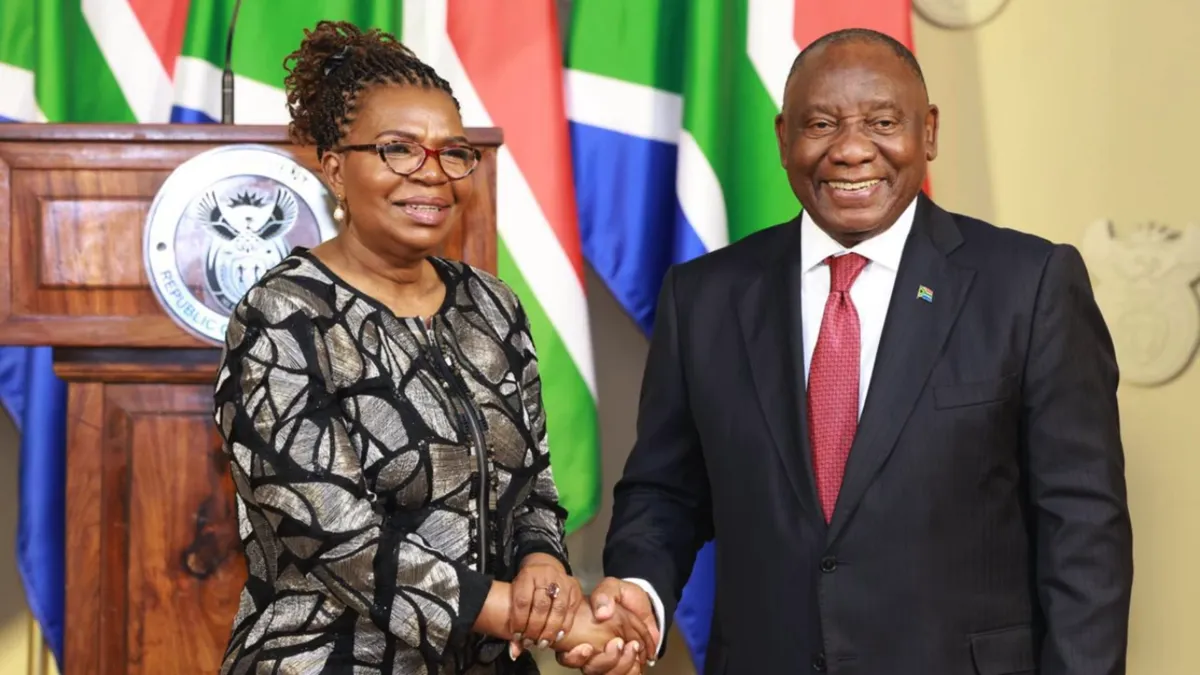
Dina Pule is back. Fired in disgrace over a decade ago under Jacob Zuma’s administration, the controversial politician has returned to the heart of South Africa’s executive.
The announcement on Tuesday night, June 30, 2026, sent shockwaves through South Africa’s political establishment. As part of a broader cabinet reorganisation following consultations with the Democratic Alliance, President Cyril Ramaphosa appointed Pule as the new Minister of Social Development. Pule fills the position left vacant after the dismissal of Sisisi Tolashe, who faced her own allegations of undeclared gifts and irregular appointments. They promised renewal. They promised ethical leadership. They delivered Dina Pule. For a president who has spent nearly ten years positioning himself as the architect of clean governance, resurrecting a politician whose name remains synonymous with systemic looting is a profound political error.
The Legacy of the Louboutin Scandal
To understand the outrage surrounding her appointment, we must look back at her tenure as communications minister from 2011 to 2013. Pule was subjected to the harshest sanctions permissible by National Assembly regulations before Zuma eventually dismissed her. A subsequent Public Protector report found that she had acted unlawfully, abused state resources, and persistently misled Parliament. The core of the scandal involved her boyfriend, Phosane Mngqibisa, who benefited from a scheme that funnelled millions of rands from the 2012 ICT Indaba into his personal accounts, including funding luxury overseas trips and the famous red-soled Louboutin shoes. By placing her in charge of Social Development, the state is handing one of its largest budgets to an individual who has proven herself utterly unfit to manage public funds.
A massive budget. A failing department.
Three Critical Risks of Pule’s Appointment
The Department of Social Development is not just another bureaucratic portfolio; it is the final line of defence against starvation for over twenty-eight million vulnerable South Africans who rely on social assistance, including the R370 Social Relief of Distress grant. The return of Pule threatens the integrity of this department in three major ways:
- Shattering Public Trust in Moral Renewal: By rehabilitating a politician with a well-documented record of corruption, Ramaphosa has shown that internal ANC factionalism and cadre deployment standards still override ethical behaviour, rendering the party's "renewal" campaign hollow.
- Exacerbating Financial Maladministration: The department has repeatedly been flagged by the Auditor-General for massive irregular and wasteful expenditure, and placing an unrepentant, previously censured minister at the helm threatens to worsen these systemic financial leaks.
- Destabilising the Government of National Unity: The Democratic Alliance and other coalition partners have fiercely condemned the appointment, with DA MPs already demanding an immediate, comprehensive lifestyle audit of Pule to establish a baseline of her assets and finances.
"It is a slap in the face of everyone advocating for just and accountable governance. To choose someone who had been embroiled in corruption at her previous ministry to manage social welfare is deeply cynical," argues Lebo Ramafoko, executive director of Corruption Watch. This warning reflects the broader consensus among civil society that the department has been treated as a political dumping ground for ANC Women's League leaders rather than a critical social service. While her supporters point to her seniority within the league as justification, the reality is that the poor will bear the cost of this political horse-trading. If Ramaphosa hopes to preserve any semblance of integrity in his administration, he will find that some political compromises are simply too expensive for the country to afford.