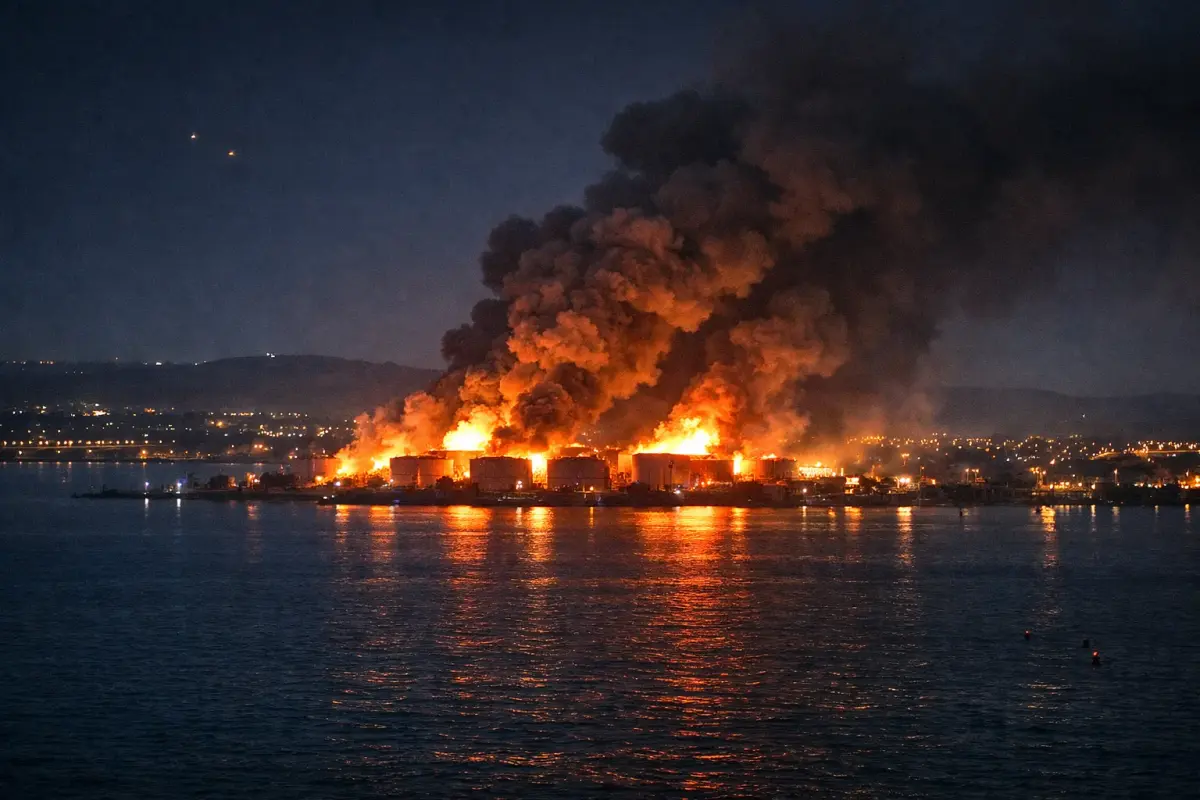
The Main Event: A massive wave of over 300 Ukrainian drones launched simultaneously against targets inside Russia and occupied territories.
The Reaction: Vladimir Putin orders immediate countermeasures to neutralize the threat, while Western reports point to a deepening domestic fuel crisis.
The Data: Russia loses 25% of its gasoline production, forcing the Kremlin to debate a total ban on diesel exports.
The Midnight Hits: Simferopol to Sevastopol
Simferopol is under attack. The Ukrainian portal Glavcom reported a rapid series of explosions cutting across occupied Crimea, stretching from the central hub to the naval base at Szevasztopol. Local witnesses told NV.ua that detonations in Simferopol were strong enough to shake doors and windows in residential areas. Further east, a direct hit disabled a railway junction in the Kirovske district. The frontline channel Intel Slava claims the strike successfully knocked out an active Russian air defense system operating near the tracks.
On the other side, defensive measures were immediately activated. The Russian state news agency RIA Novosti announced that air defense units and mobile interception groups repelled the attack in waves, downing nine Ukrainian UAVs in sequence over the skies of Sevastopol. Meanwhile, the military analysis channel Рыбарь (Rybar) confirmed that the strikes targeted Crimea's logistical chains and its peak tourist season. Satellite imagery reveals that a massive fire at the Kerch oil terminal has left at least four out of seven fuel tanks currently ablaze.
Putin’s Ultimatum and Kyiv’s Drone Wings
Moscow is furious. During a meeting with graduates of military academies cited by Vedomosti, Vladimir Putin declared that the West fails to comprehend the consequences of providing technological assistance for deep-tier strikes. The Russian president claimed that Kyiv's attacks aim to incite panic but will not stop Russian forces from seizing new territories on the frontline "each and every day." Sergei Shoigu and Aleksandr Bortnikov, heads of the security services, added via Vechernyaya Moskva that intelligence agencies are working around the clock on countermeasures, and "harsh punishment" awaits the leadership in Kyiv.
Kyiv, however, is not backing down. The Kyiv Post, drawing on background information from the Financial Times, pointed out that Ukrainian drone successes have made Donald Trump increasingly receptive to supporting Ukraine, causing deep frustration in the Kremlin. Furthermore, the frontlines are escalating on a technological level: Ukrainian military sources report that the Russians are already experimenting with unmanned assault boats along the Ukrainian coast, outfitted with Starlink terminals to extend their operational range.
Russian Oil Refining in Ruins: A Diesel Ban Looms
Behind the war of words lie stark energy data. According to an analysis by the international news agency Reuters, recent strikes on refineries have caused Russia to abruptly lose 25% of its gasoline production capacity. Deputy Prime Minister Aleksandr Novak, as reported by ANNA NEWS, admitted in a Kremlin meeting that existing refineries had to be pushed to maximum capacity, forcing several scheduled maintenance windows to be postponed to avert market shortages.
The situation is so critical that Операция Z (War Correspondents) reports the Russian government is considering a total ban on diesel exports, especially after parts of Crimea were left without power and water due to the latest grid strikes. According to data from Meta News UA, strict volume limits on retail gasoline sales have already been introduced in four additional Russian regions, signaling clearly that the logistical and economic toll of the war has broken directly into the daily lives of the Russian home front.