Kast took office on March 11. He did not wait long. Within weeks, his administration ordered across-the-board budget cuts of nearly 3 percent across all ministries — part of an aggressive plan to slash roughly $6 billion in public spending over 18 months. The Health Ministry took the hardest hit: $486 million. Education was next, down $221 million. The government called it fiscal consolidation. A lot of Chileans called it something else.
June 1 was the flashpoint. Kast delivered his first State of the Nation address in Valparaíso. Outside, the streets were already blocked.
Labour unions and student groups had gathered to meet him there. They accused his government of dismantling public healthcare, gutting education and rolling back what was won in the years after the 2019 social uprising — the estallido social that shook the country and forced a reckoning over inequality. Kast told parliament his cuts would cause "pain" but insisted social rights would not be touched. The protesters were not buying it.
Two days later, Santiago.
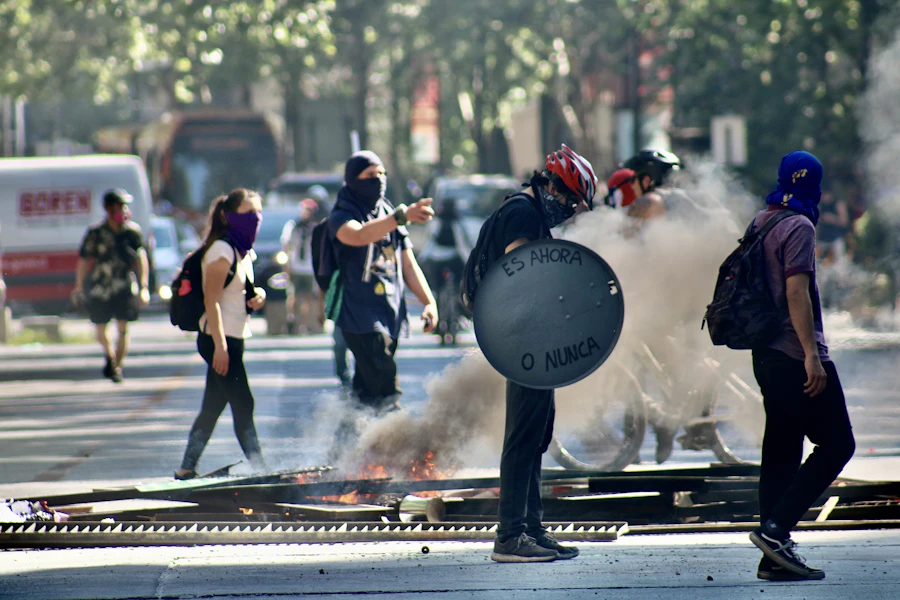
The Confederation of Chilean Students — CONFECH — called a general strike and a mass march through the capital. It started peacefully. It did not stay that way. Police moved in with water cannons and tear gas. Some demonstrators threw rocks and Molotov cocktails. Metro stations shut down across central Santiago. By the end of the day, at least 25 people had been injured — including 12 police officers — and 35 protesters had been arrested. A law student serving as a human rights observer underwent emergency surgery for facial fractures.
"The government sought to provoke this, to create this situation to justify repression," said Mario Aguilar, president of the Chilean Teachers' Union.
The marchers were not one crowd with one complaint. University students fear the end of free higher education — a right they trace back to the street battles of 2006 and 2011. Secondary school associations worry about school meal programmes that feed hundreds of thousands of children from low-income families. Feminist groups joined in. So did trade unions from sectors well outside education.
"Free higher education was a right won through mobilisation," said Angy Moran, a CONFECH spokesperson. "We have to defend it."
Kast's position is that Chile cannot afford the status quo. His administration points to years of fiscal drift and argues that structural reform is the only path to sustainable growth. The National Reconstruction Bill — already approved by the Chamber of Deputies in late May and now heading to the Senate — packages the cuts alongside deregulation measures and private investment incentives. His backers say it is exactly what the economy needs. His critics call it a blueprint for inequality.
The criticism is not only coming from the left. Some members of Kast's own governing coalition have raised concerns about the pace and depth of the cuts — a rare crack in a government that came to power on a platform of discipline and order.
None of this is entirely new for Chile. The country has cycled through exactly this dynamic before: a government pushes economic reform, the streets push back, and the world watches to see which gives first. What is different now is the starting point. The 2019 uprising left a generation of Chileans with a specific vocabulary for grievance — and a specific memory of what mass mobilisation can achieve.
Whether June's protests are the beginning of something sustained, or a loud but contained reaction to a government with a solid congressional mandate, is still an open question. The Senate debate on the National Reconstruction Bill will be the next test. So will September, when Chile marks the anniversary of the 1973 coup — a date that has never been just a date in this country.
For now, the water cannons have been cleaned and put away. The metro is running again. But the anger that filled Santiago's streets on June 3 did not disappear with the crowds.
It rarely does in Chile.