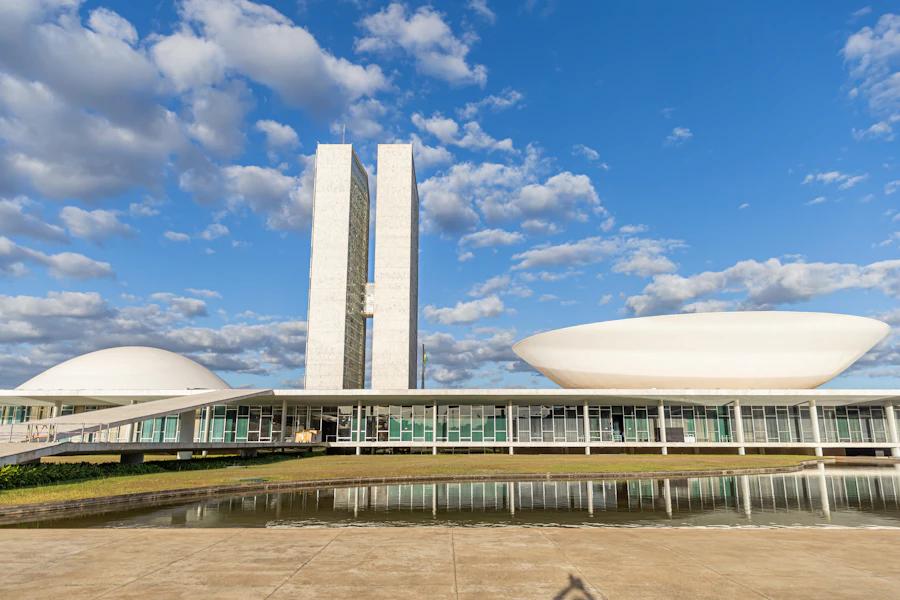
Brazil's institutions spent April and May 2026 colliding with each other in a way the country hadn't seen in decades. On April 29, the Senate rejected President Lula's Supreme Court nominee, Jorge Messias, by a vote of 42 to 34 — the first time in 132 years of republican history that Brazil's Senate had blocked a presidential nominee to the court. The next day, Congress overrode Lula's veto of the so-called Dosimetry Law, which slashes sentencing for crimes including attempted coup d'état, by margins of 318-144 in the lower house and 49-24 in the Senate. After Lula let the promulgation deadline lapse without further action, Senate President Davi Alcolumbre signed the law into force on May 8. One day later, Supreme Court Justice Alexandre de Moraes suspended it entirely, freezing the case of former President Jair Bolsonaro along with more than 190 other January 8 defendants.
What the law was actually built to do
The Dosimetry Law changes how Brazilian courts calculate sentences for multiple convictions arising from the same context: rather than serving cumulative penalties for each offense, a defendant now serves only the sentence for the single most serious crime. It also allows reductions of one-third to two-thirds for people convicted as part of a crowd, provided they weren't organizers or financiers, and lowers the threshold for progressing from closed to semi-open prison conditions. For Bolsonaro specifically — sentenced to 27 years and three months for his role in the January 8, 2023 attack on Brazil's government buildings — the practical effect would be dramatic. Pre-law projections put his progression to semi-open conditions around 2033; under the new calculation, analysts estimated his time in closed detention could fall to as little as two years and four months, with release to semi-open status possible as early as 2028.
The bill's path through Congress revealed where its real support came from. It wasn't passed by Bolsonaro loyalists alone — centrist senators proved decisive, with Senator Alessandro Vieira explicitly distinguishing between January 8 rioters who were "organizers" and those "used as pawns." Some political reporting has framed the bill as a bargaining chip aimed less at freeing Bolsonaro outright than at persuading his family to withdraw Flávio Bolsonaro from the 2026 presidential race in favor of a less polarizing right-wing candidate — a read that, if accurate, makes the law as much an intra-coalition negotiating tool as a sentencing reform.
A court that froze it in 24 hours — and still hasn't ruled
Justice Moraes, who serves as rapporteur on the original Bolsonaro prosecution, suspended the Dosimetry Law's application on May 9 while acting on two Direct Unconstitutionality Actions filed by the Brazilian Press Association and the PSOL-Rede party federation. Those challenges argue the law was constructed to selectively benefit people convicted of trying to destroy Brazil's democratic order, making it discriminatory on its face. Moraes gave the presidency and Congress five days to respond and has since requested further information from all parties — a process that, as of late June 2026, still hasn't produced a plenary ruling, despite Justice Gilmar Mendes publicly stating in May that a decision would arrive "within a few days."
Mendes's more recent public comments suggest the court itself is in no hurry to force the issue before the election. Asked in May whether Lula might resubmit Messias's rejected nomination before October, Mendes demurred, noting Brazil is "very close to the elections," and predicted that public attention would only sharpen "once the World Cup concludes" — after which, he said, "we will have a completely different scenario in Brazil, discussing a new government. At that point, other developments may follow." Read plainly, a justice on Brazil's highest court is suggesting that some of the country's most consequential constitutional questions may simply wait until voters decide who they're being decided for.
A court arguing with Congress while short-staffed
The standoff is unfolding with one of the Supreme Court's eleven seats still vacant, after the Messias rejection — itself unprecedented — left Lula without a confirmed replacement. Critics across the political spectrum, including some sympathetic to the court's role in the Bolsonaro prosecution, have argued that the STF's expanding influence over Brazilian politics — acting simultaneously as investigator, prosecutor, and judge in the January 8 cases, and now as the body deciding whether Congress can retroactively soften punishment for the very crime it prosecuted — has stretched the institution's traditional role past where most constitutional courts operate. Whether that expanded role still commands enough legitimacy to make a ruling stick, in either direction, is arguably the deeper question the Dosimetry case poses, independent of what happens to Bolsonaro's sentence specifically.
Why this doesn't resolve cleanly before October
Senator Flávio Bolsonaro, the former president's son and a declared 2026 presidential candidate, has cast Moraes's suspension as judicial overreach into a sovereign legislative decision — a framing likely to feature heavily in his campaign regardless of how the STF eventually rules. A decision upholding the law would hand him and the broader right a concrete grievance against the court heading into the election. A decision striking it down would hand the same coalition a different grievance: that an unelected court overturned a twice-passed congressional override. Either outcome arrives into an election where, per recent polling, Lula's approval has spent much of his term underwater, and where his administration suffered two consecutive defeats — the Messias rejection and the veto override — within 24 hours of each other in late April. The Supreme Court's eventual ruling on the Dosimetry Law won't just decide how long Jair Bolsonaro stays in prison. It will arrive as one more data point in a campaign already organized around the question of how much authority Brazil's courts should have over its elected branches — a question that, as Justice Mendes himself suggested, may not get a clean answer until after Brazilians have already voted.