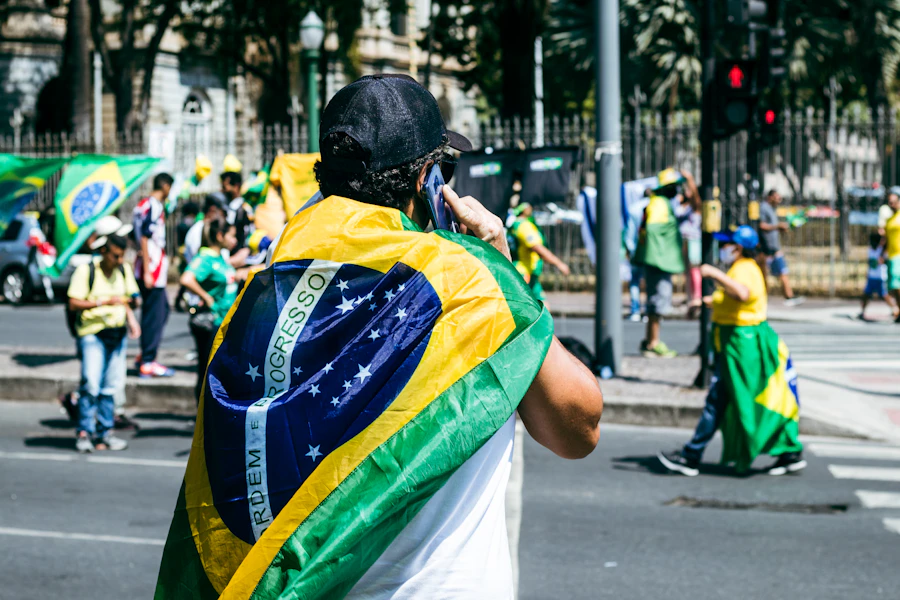
Brazil's October 2026 general election pits President Luiz Inácio Lula da Silva, seeking a fourth term, against Senator Flávio Bolsonaro, the imprisoned former president's eldest son and chosen successor. Domestic coverage frames it the way most elections get framed — left versus right, incumbent versus challenger. Foreign policy analysts increasingly describe it differently: as a referendum on whether Brazil controls the terms on which the world accesses what's inside its borders, or whether those terms get set elsewhere.
Why geography suddenly matters again
For roughly three decades, globalization carried an implicit lesson that physical geography mattered less and less to economic power. That assumption is unwinding. The global economy is increasingly organized around control of land-based resources — critical minerals, farmland, clean energy potential, fresh water, carbon-absorbing forest — and Brazil holds an unusually large share of all of them simultaneously. The country has the world's second-largest rare earth reserves, vast pre-salt offshore oil deposits, the Cerrado's expanding agricultural frontier, one of the planet's largest freshwater systems, and roughly 60% of the Amazon rainforest. Each of those assets has, over the past eighteen months, become the subject of direct foreign pressure: an American mining company's $2.8 billion acquisition of Brazil's only rare earth mine, a U.S. tariff fight justified partly by deforestation claims, and a carbon-finance architecture for the Amazon still being negotiated among foreign donors and Brazilian institutions that haven't yet figured out how to issue compliant credits at scale.
Two very different bets on how to handle that pressure
Lula's approach, consistent across his first two terms and this one, has been what foreign policy scholars call "active non-alignment" — refusing to choose definitively between Washington and Beijing while extracting leverage from both relationships. That stance was visible when Brazil initially appeared to be moving toward signing onto China's Belt and Road Initiative around a 2024 state visit by Xi Jinping, then ultimately declined, even as it had separately vetoed Venezuela and Nicaragua from joining BRICS — a sequence that read in foreign media as a tilt toward Washington, though Brazilian officials describe it as case-by-case calculation rather than alignment. Lula has paired that posture with an outsized diplomatic footprint: chairing BRICS in 2025, hosting COP30 in Belém in November 2025, and attempting (with limited concrete impact) to position Brazil as a mediator in conflicts from Ukraine to Venezuela.
Flávio Bolsonaro has signaled a different bet: closer alignment with the Trump administration, mirroring the approach his father took as president from 2019 to 2022. Critics of that approach — including the foreign policy scholars who have studied the elder Bolsonaro's term — argue the trade-off is asymmetric: a louder claim to ideological alignment with Washington in exchange for reduced negotiating leverage on trade, weaker environmental enforcement that invites further international scrutiny of the Amazon, and a diminished seat at the tables where rules governing critical mineral supply chains and carbon markets are actually being written.
The stakes show up first in commodity prices
The abstraction of "foreign policy" translates into concrete numbers for Brazilian producers faster than most voters register. The price a Brazilian soybean farmer receives is shaped by trade architecture that depends on the state of U.S.-China competition. Whether Amazon conservation generates revenue through functioning carbon markets — or remains, as it has for most of the past decade, an expensive liability with no buyer — depends on international frameworks Brazil either helps design from a position of credibility or has imposed on it from outside. The industries expected to employ the next generation of Brazilian workers, including critical mineral processing and renewable energy manufacturing, all depend on technology partnerships and investment terms negotiated at the international level, not the domestic one.
An election that foreign capitals are already watching
Polling through mid-2026 shows a closely contested race, with Lula's approval ratings underwater for much of his term amid persistent inflation and a polarized Congress. What makes this election unusual by Brazilian historical standards, according to foreign policy researchers tracking it, is that international actors — from Washington trade negotiators to Beijing-linked mining investors to the donor countries funding Amazon carbon finance — are positioning themselves for either outcome well before votes are cast, because the resource questions at stake don't pause for an election cycle. Whichever candidate wins in October will inherit not just a domestic economy under strain, but a series of live negotiations over rare earth processing rights, tariff terms, and rainforest carbon credits that were already in motion — and will keep moving regardless of who is in the room representing Brazil.