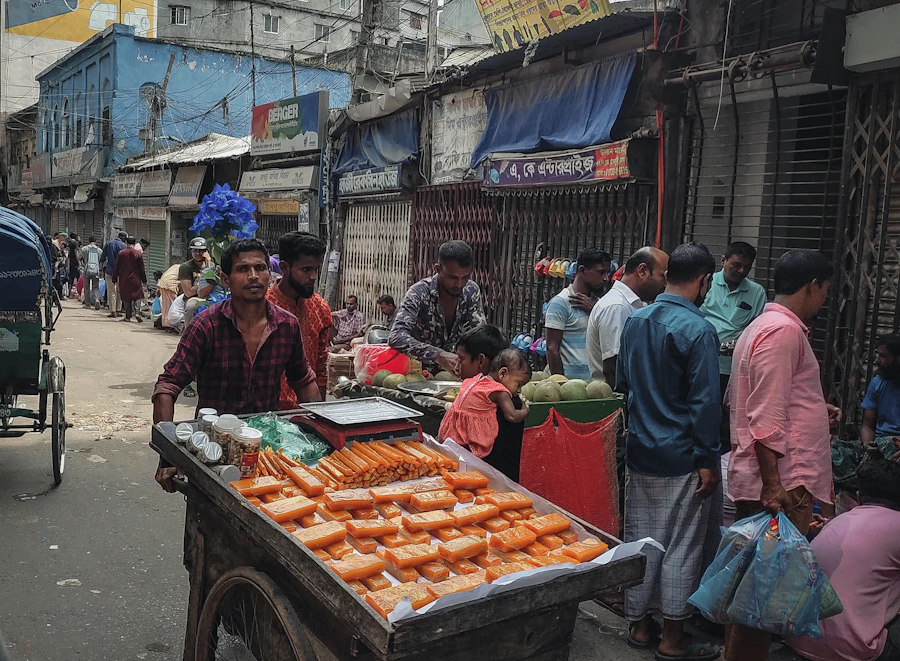
Walk through any bazaar in Dhaka today and the arithmetic is brutal. A family that spent 6,000 taka a month on groceries in 2021 now needs closer to 10,000 to buy the same basket of goods. Their wages have gone up — but not nearly that far. Across Bangladesh, the gap between what workers earn and what their money buys has quietly become one of the most consequential economic stories in South Asia.
The numbers behind the pain
Bangladesh's general inflation rate stood at 8.71 percent in March 2026, down from a peak above 10 percent in late 2025 but still far above the levels Bangladeshis lived with for most of the previous decade. Food inflation has been consistently higher than the headline figure, hitting families hardest at the point where they have the least flexibility. Since 2021, the taka has lost approximately 43 percent of its value against the US dollar — a collapse driven by a combination of import costs, foreign reserve depletion, and the political and economic chaos that followed the mass uprising of July–August 2024. The World Bank, IMF, and Asian Development Bank all project a modest recovery in GDP growth for FY2026, converging around 4.7 to 5 percent. But economists warn that headline growth numbers will feel abstract to the millions of households whose real purchasing power has declined significantly over the past three years.
Wages that can't keep up
Data from Bangladesh's own statistics bureau tells a stark story: in December 2025, price inflation rose by 0.20 percentage points while wage inflation increased only marginally — from 8.04 percent to 8.07 percent. That gap, small as it sounds in any single month, has been compounding for years. Real wages — what a worker's pay actually buys — have fallen. The garment sector, which employs an estimated 4.4 million workers and generates around 35 percent of Bangladesh's export earnings, saw its minimum wage raised to 12,500 taka per month in late 2023 following mass protests. At the exchange rate and price level of the time, that was a meaningful increase. At today's rates and prices, it has been largely swallowed by inflation before workers could benefit from it.
A development miracle under pressure
The cruelest dimension of the current squeeze is the context in which it is happening. Bangladesh spent five decades building one of the great development success stories: poverty rates fell dramatically, life expectancy rose, female workforce participation expanded, and per capita income climbed steadily. The country is on track to formally graduate from Least Developed Country status in November 2026 — a recognition of genuine progress. But that graduation will also mean the gradual withdrawal of preferential trade access that currently covers roughly 70 percent of Bangladesh's global exports. The country is being asked to compete on more equal terms with wealthier economies at precisely the moment when its domestic economic buffers are most stretched.
Private investment fell to 22.48 percent of GDP in FY2025, its lowest level in five years. Bangladesh's tax-to-GDP ratio sits at just 6.8 percent — one of the lowest in Asia — leaving the government with little fiscal room to cushion the impact of inflation on vulnerable households without borrowing. The banking sector, burdened by years of poor governance and non-performing loans, continues to restrict the credit flows that businesses need to invest and hire.
What recovery actually looks like
The interim government that took power after the 2024 uprising has initiated banking sector reforms and worked with the Bangladesh Bank on exchange rate stabilisation. Foreign exchange reserves recovered to US$33.19 billion in December 2025, and remittance inflows — hitting a near-record $3.22 billion in the same month — have provided a crucial buffer. Economists at the Centre for Policy Dialogue argue that stabilising the macroeconomic environment must remain the top priority, and that inflation control will require a careful balance between monetary tightening and fiscal support for the most vulnerable.
But recovery in the macroeconomic data and recovery in people's lives are not the same thing. Even if inflation falls to 7 percent by the end of FY2026 as some projections suggest, that will mean prices stabilising at a level that is already far above where they were when the current crisis began. The gains of a generation have not been wiped out — but they have been eroded in ways that will take years to rebuild, and that will shape the political and economic landscape of Bangladesh long after the headline numbers have improved.