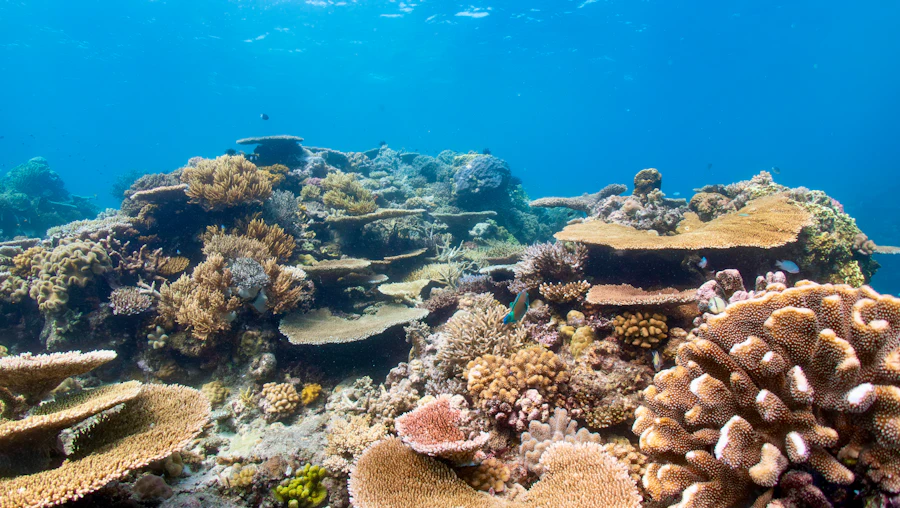
The Great Barrier Reef has survived ice ages, sea level shifts, and millions of years of geological upheaval. What it has never faced before is an ocean warming at the pace scientists are now measuring — and the bleaching events that follow are stripping vast stretches of coral faster than natural recovery can keep up. A team at the Australian Institute of Marine Science (AIMS) in Townsville believes a technique borrowed from agriculture could change that calculus.
Helping nature along
The approach is called Assisted Gene Flow: take corals that have already survived marine heatwaves in the warmer northern reaches of the reef, cross-fertilise them with corals from the cooler central sections, and see whether the offspring inherit the heat tolerance of their northern parent. AIMS divers collected heat-hardened corals from the far north and flew them nearly 1,000 kilometres south to the National Sea Simulator in Townsville, where researchers produced dozens of distinct genetic crosses. The resulting seven-month-old juveniles — hundreds of them, growing on terracotta tiles — were then transplanted onto the central reef in the first large-scale feasibility test of the technique on the Great Barrier Reef.
Early results
The transplanted corals have survived on-site. Laboratory work at the National Sea Simulator had already shown that juveniles with at least one northern parent are significantly more likely to endure high temperatures. Dr Kate Quigley, the AIMS marine scientist leading the project, said the field results support further testing of Assisted Gene Flow "as a management action tool for corals in a warming future." Dr Line Bay, who leads AIMS research into reef recovery and restoration, framed the technique as working with biology rather than overriding it: the reef's corals do migrate and interbreed naturally — just far too slowly to keep pace with current warming rates.
A parallel push: CRISPR in the lab
A separate collaboration involving AIMS, Stanford University, and Queensland University of Technology has used CRISPR-Cas9 gene-editing to identify specific genes responsible for heat tolerance in Acropora millepora, one of the reef's most ecologically important coral species. That research, published in the Proceedings of the National Academy of Sciences, does not yet involve releasing gene-edited organisms into the ocean — regulatory frameworks for that remain in early development — but it is building the scientific foundation that could eventually make targeted genetic interventions possible at scale.
The wider stakes
The 2024 bleaching event was the most extensive ever recorded on the reef, following mass bleaching in 2016, 2017, 2020, and 2022. The Assisted Gene Flow trials are funded under the Australian Government's Reef Trust and the Great Barrier Reef Foundation as part of a broader portfolio of intervention techniques — no single solution is expected to be sufficient on its own. Researchers will return to the transplant site periodically to monitor growth, reproduction, and ecological integration. Those long-term results will determine whether Assisted Gene Flow moves from promising experiment to mainstream reef management tool.